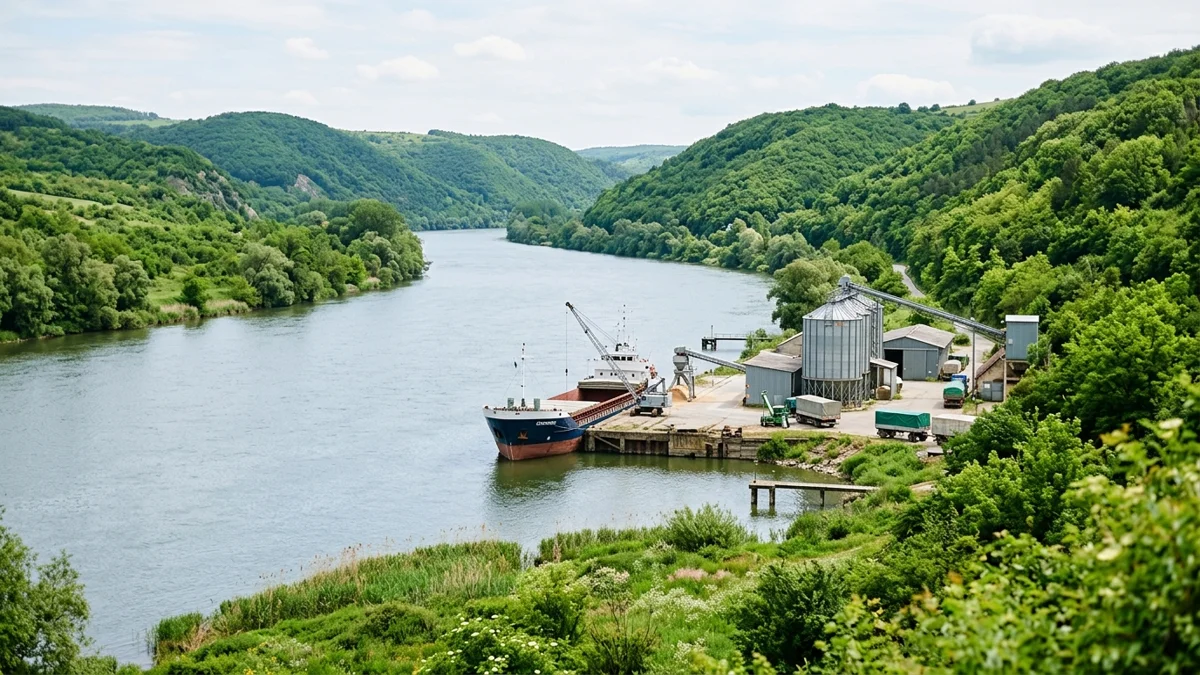
Drought reduced Danube corridor capacity. How vessel draught, grain accumulation, storage and road logistics now affect shipment planning and cost.

Abnormal drought in August 2026 reduced the capacity of the Danube transport corridor. Ukraine's Parliamentary Committee on Agrarian and Land Policy reported the constraint during a discussion of agricultural exports and storage. Part of the cargo flow has had to shift to road and rail routes.
Why the water level affects unit cost
At a lower navigable depth, a vessel may be unable to take its planned cargo without exceeding the permitted draught. This reduces the useful load per voyage and increases freight, port and agency costs per tonne. Our guide to vessel draught on the Danube explains the operational relationship.
Low water does not automatically halt every operation. It means vessel particulars, actual depth, cargo size and loading schedule should be checked close to the call date rather than based on seasonal averages.
How much can alternative routes absorb
According to the Committee, rail currently carries around 800,000–900,000 tonnes of agricultural cargo per month. Some flows also shift to trucks. Replacing one mode with another is not enough on its own: the route still needs accumulation points, intake slots, laboratory control and coordination with the vessel.
A practical checklist for cargo owners
- check the permitted draught and approach conditions at the specific berth before fixing a vessel;
- split the cargo into accumulation stages and confirm port-side storage;
- maintain a backup truck schedule and agree the receiving sequence;
- compare the cost of underloading with a different vessel type or size;
- recalculate CPT/FOB after any route or freight-rate change.
The role of Lower Danube ports
Kiliya, Izmail and Reni operate as a network of alternative nodes, not as identical substitutes. The right choice depends on grain origin, vessel particulars, queues and available infrastructure. Kiliya Port can be particularly practical for cargoes from southern Odesa region when the road leg is a major cost driver.
During low water, the winning route is not the longest one but the best synchronised: farm, transport, storage, laboratory and vessel.
The priorities identified by the authorities include targeted logistics upgrades and expanded grain storage. For business, this is a signal to build contingency not only into transport but also into timing and accumulation capacity.
Source: Верховна Рада України
Need grain transshipment or storage?
Grain terminal in Kiliya on the Danube. We'll map out your export route.
Contact us