How to choose a grain storage facility in Ukraine for an export lot: quality, segregation, records, losses, logistics and total cost.
Days or weeks may pass between purchasing grain and loading a vessel. During that period, grain storage before export has two jobs: preserve contractual quality and accumulate the required shipment volume. A poor storage decision may only become visible at the port, through increased moisture, mixed grades, off-spec results or missing records.
Start with the export contract
Before the first truck arrives, record the crop and grade, permitted moisture and foreign matter, safety parameters, minimum lot size and readiness date. The facility must understand the buyer's specification, not only domestic grades. Mixing rules matter: sound grain from two origins may still have different analytical characteristics.
Quality at intake
FAO guidance identifies safe moisture, freedom from insects and temperature control as fundamental to preserving bulk grain. A wet or infested lot cannot simply enter a common bin: it can cause self-heating, mould and losses across the whole stock. Intake therefore needs representative sampling, a clear laboratory record and a defined decision — accept, clean, dry or reject.
- Record the quality of every truck or assembled intake lot.
- Keep separate bins for different crops, grades and owners.
- Confirm aeration, temperature monitoring, cleaning and drying capabilities.
- Agree a retesting and reference-sample procedure for disputed results.
Silo or flat warehouse?
Silo storage suits automated movement, temperature monitoring and fast load-out. A flat warehouse can be economical for large homogeneous lots and allows flexible use of floor space. The right choice depends less on the building name than on equipment condition, protection from moisture and pests, lot segregation and dispatch speed.
Records and traceability
Every intake should connect its transport document, weight record, laboratory result and warehouse ledger. This traceability helps assemble a consistent vessel parcel and resolve discrepancies. Export documents depend on the commodity and destination; regulated plant products require an advance check of current phytosanitary conditions. Ukraine's official requirements and destination-country information are published by the State Service of Ukraine on Food Safety and Consumer Protection.
Calculate total cost, not the headline rate
A per-tonne-per-day rate is only one line. Add intake, weighing, analysis, cleaning or drying, internal movements, fumigation, dispatch and any agreed handling loss. Then calculate transport from storage to port. A cheap inland elevator may lose to a more expensive port-side facility once a second haul and the risk of missing the vessel window are included.
For an exporter, the best storage facility is not the one with the cheapest day rate; it is the one that releases the required volume, on specification, at the vessel's loading pace.
Seven questions for a storage operator
- Which crops and grades are currently stored alongside mine?
- How are reference samples taken, sealed and retained?
- Which parameters are monitored during storage, and how often?
- What are the actual intake and dispatch rates per shift?
- What is included in the base tariff and charged separately?
- How are quantity and quality discrepancies documented?
- Can dispatch be synchronised with the vessel's loading window?
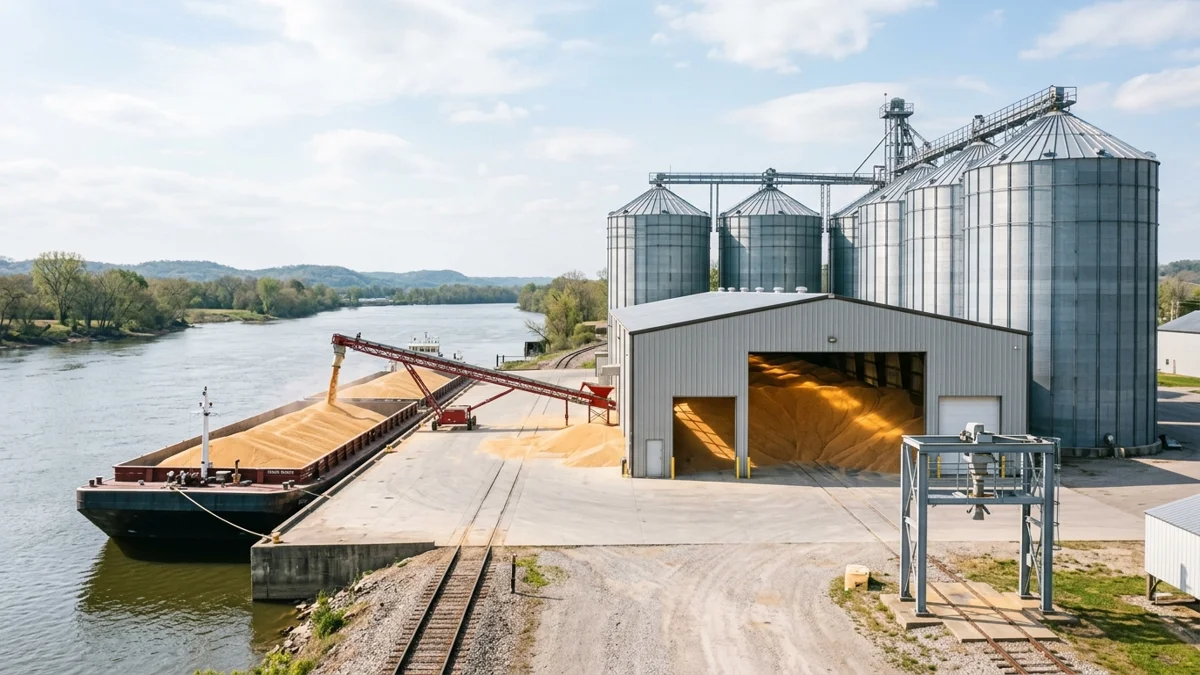
Storing grain beside the berth removes a second long-distance haul from the chain. GTK combines grain storage and port transshipment in Kiliya. For a lot calculation, provide the crop, quality, volume, expected storage period and vessel direction through our contact page.
Need grain transshipment or storage?
Grain terminal in Kiliya on the Danube. We'll map out your export route.
Contact us